

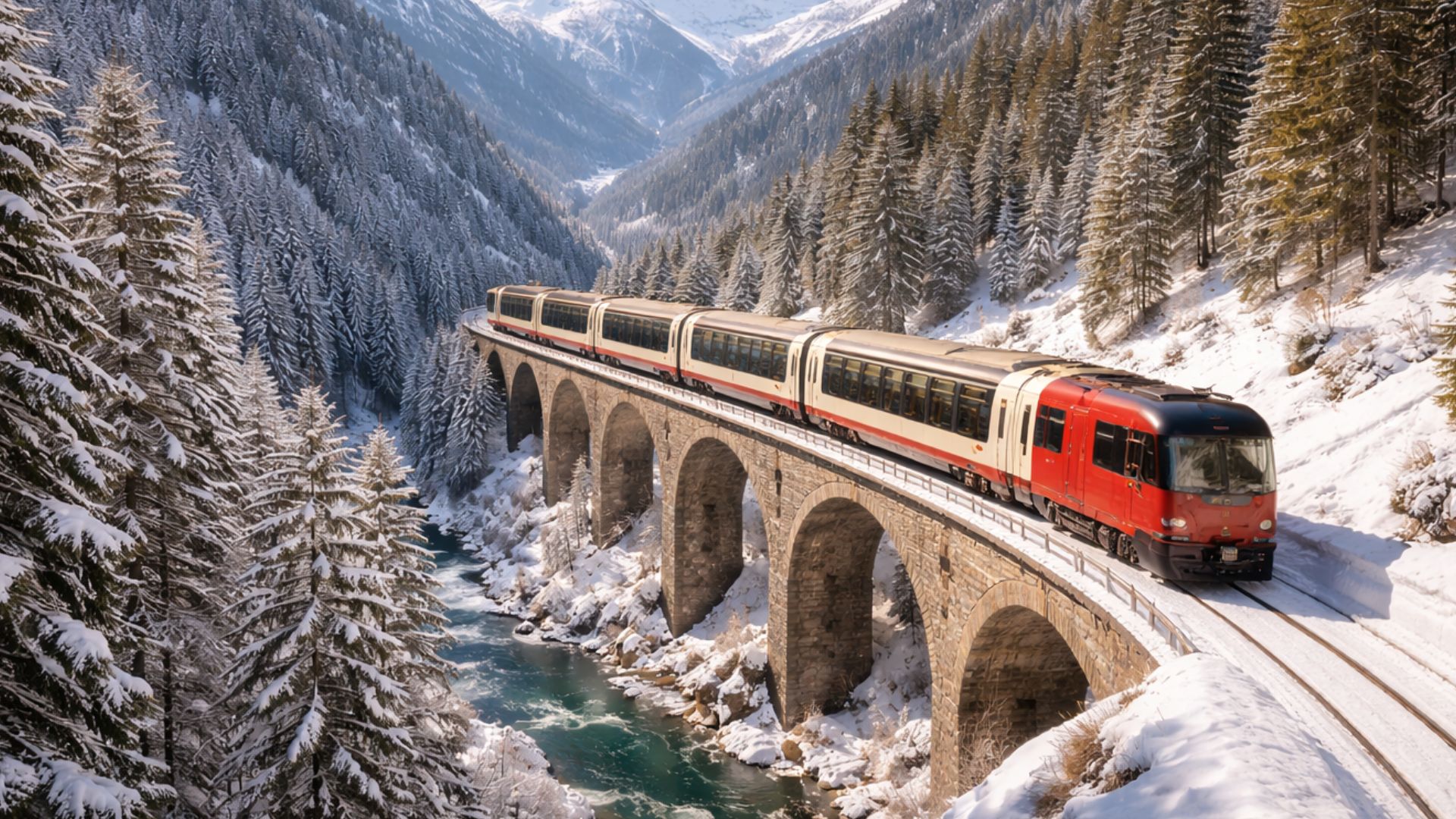







In the architecture of global wealth, speed has long functioned as a proxy for power. Private aviation reduced friction, compressed geography, and signaled command over time itself. Yet a quiet behavioral shift is emerging among ultra-high-net-worth individuals, family offices, and globally mobile founders who are reassessing how mobility aligns with reputation, sustainability, and cultural capital. Increasingly, curated high-end rail journeys through the Swiss Alps and greater Europe are becoming a deliberate alternative to short-haul private jet segments.
This is not a rejection of private aviation, which remains structurally embedded in wealth management logistics. Instead, it is a recalibration of visible mobility. Luxury rail is being repositioned as an instrument of narrative control, environmental signaling, and refined social positioning within elite networks. For those who already command speed, the strategic choice to slow down communicates something more nuanced.
The renewed interest in premium rail experiences such as the Glacier Express, the Bernina Express, and Belmond’s Venice Simplon-Orient-Express reflects broader shifts in luxury behavior. As generational wealth transitions to younger stewards who prioritize sustainability, governance transparency, and curated experiences, mobility itself is becoming part of the brand architecture of wealth.
Speed Versus Signaling: The Evolution Of Elite Mobility
Private aviation remains central to ultra-high-net-worth infrastructure. According to Knight Frank’s Wealth Report and aviation industry analyses from publications such as Corporate Jet Investor, private jet usage expanded significantly in recent years, reflecting both efficiency demands and health-related travel preferences. For principals managing global portfolios, private aviation continues to serve an operational function.
However, speed no longer operates as the sole indicator of influence. In a climate where climate disclosure, carbon accountability, and ESG frameworks increasingly intersect with wealth strategy, visible overreliance on private jet travel can create reputational friction. UBS Global Wealth Report commentary highlights how next-generation wealth holders often prioritize sustainability alongside capital growth and preservation.
Luxury rail offers a different signaling mechanism. Choosing to travel across the Swiss Alps via panoramic train rather than short-haul aircraft does not compromise access. Instead, it reframes movement as experiential and environmentally conscious without abandoning comfort or exclusivity.
For wealth strategists and family offices managing multigenerational narratives, this distinction is increasingly meaningful. Mobility choices contribute to the broader governance story surrounding how wealth is exercised in public view.
The Swiss Alps As A Controlled Luxury Environment
Switzerland occupies a unique position within global wealth architecture. It functions simultaneously as a private banking hub, a diplomatic center, and a discreet leisure landscape. According to the Global Financial Centres Index and reporting from the Swiss Bankers Association, Swiss financial institutions continue to manage a substantial share of cross-border private wealth.
The Swiss Alps provide a physical extension of this financial ecosystem. Destinations such as St. Moritz, Zermatt, Gstaad, and Andermatt operate as seasonal convergence points for global capital. Yet unlike Mediterranean marinas or high-visibility beach enclaves, Alpine environments offer structured privacy and controlled density.
Premium rail journeys like the Glacier Express, which connects St. Moritz and Zermatt, are engineered for scenic immersion and operational reliability. The route traverses 291 bridges and 91 tunnels, moving through landscapes that emphasize continuity and engineering precision. The train’s Excellence Class cabins, concierge service, and curated dining elevate the journey beyond transport into a contained hospitality environment.
This controlled setting allows principals to host partners, family members, or advisors in a context that feels intentional rather than performative. The geography reinforces stability and tradition, qualities historically associated with Swiss governance and wealth stewardship.
Slow Travel As Cultural Capital
Cultural capital in contemporary elite circles increasingly hinges on discernment rather than accumulation. It is not the quantity of destinations that signals sophistication, but the depth of engagement. Luxury rail, particularly through historically and geographically significant regions, reinforces this narrative of cultivated travel.
The Venice Simplon-Orient-Express operated by Belmond exemplifies this dynamic. With restored 1920s carriages, formal dining protocols, and multi-day itineraries linking cities such as Venice, Paris, and Vienna, the experience references Europe’s pre-aviation era of aristocratic movement. It embeds travel within historical continuity rather than transactional convenience.
Similarly, Switzerland’s Bernina Express connects Chur to Tirano across a UNESCO World Heritage railway line. The route is recognized for its engineering significance and seamless integration into mountainous terrain. Participation in such journeys signals awareness of infrastructure heritage and European industrial achievement.
For ultra-high-net-worth individuals concerned with legacy, these experiences align with long-term thinking. They situate personal leisure within narratives of craftsmanship, engineering mastery, and continental history. This layering of context transforms travel into a statement of intellectual alignment rather than consumption.
Sustainability, ESG, And The Public Optics Of Wealth
Environmental considerations are no longer peripheral in wealth management discourse. According to Deloitte’s Global Powers of Luxury Goods report and multiple ESG-focused financial analyses, sustainability has become embedded in both corporate governance and private investment strategy. Family offices increasingly allocate capital toward impact investing, renewable energy, and carbon transition technologies.
Against this backdrop, conspicuous short-haul private jet usage may conflict with stated sustainability commitments. While carbon offset programs and sustainable aviation fuel initiatives are expanding, optics remain influential in shaping public perception.
Rail travel in Switzerland is powered largely by hydroelectric energy, reflecting the country’s long-standing investment in renewable infrastructure. According to the Swiss Federal Office of Energy, Switzerland generates a substantial portion of its electricity from hydropower, reinforcing the environmental credibility of its rail network.
When ultra-high-net-worth individuals choose high-end rail for select itineraries, they integrate mobility into their ESG narrative. The decision becomes part of a broader positioning strategy that aligns lifestyle with publicly articulated values. In a digital environment where mobility can be tracked and publicized, this alignment reduces reputational volatility.
Network Formation In Contained Spaces
Elite networks are often formed in transitional spaces rather than static venues. Private aviation cabins, yacht decks, and countryside estates have historically functioned as environments where concentrated time fosters deeper connection. Luxury rail replicates this effect within a structured corridor.
On premium Swiss trains, Excellence Class compartments limit passenger numbers, creating a curated social ecosystem. Conversations unfold over extended meals and panoramic observation cars rather than rushed airport lounges. The absence of security theatrics and boarding congestion allows for continuity of dialogue.
This format is particularly attractive to family offices hosting next-generation members or cross-border partners. The journey itself becomes a strategic offsite, combining scenery with structured hospitality. It enables relationship cultivation without the overt visibility associated with large public events.
In this sense, high-end rail is not simply nostalgia. It is a contemporary tool for managing intimacy within elite networks. It offers the privacy of a yacht without maritime exposure and the continuity of a retreat without fixed geography.
Reframing Time As A Luxury Asset
Time remains the ultimate non-renewable asset in wealth strategy. Yet the framing of time is evolving. Previously, efficiency equated to compression. Today, for those who already command logistical speed, time can be reinterpreted as immersion.
Luxury rail through the Swiss Alps repositions hours not as lost productivity, but as curated experience. The panoramic windows, orchestrated service rhythms, and gradual geographic transitions encourage presence rather than acceleration. For principals navigating relentless decision cycles, this structured deceleration holds psychological value.
Moreover, choosing to allocate time to slow travel signals independence from urgency. It communicates that one’s capital position does not require constant acceleration. In elite circles, the ability to move slowly by choice can signal more authority than the ability to move quickly by necessity.
This reframing intersects with generational wealth transfer. As younger wealth holders assume leadership roles within family offices, they often integrate lifestyle design into governance philosophy. Travel becomes part of identity formation rather than a logistical afterthought.
Luxury Rail As Portfolio Diversification In Experience
Just as financial portfolios diversify across asset classes to manage risk and optimize returns, experiential portfolios are diversifying across geographies and modalities. Private aviation, maritime leisure, and Alpine rail are not mutually exclusive. They represent different instruments within the broader architecture of refined living.
The resurgence of high-end rail through the Swiss Alps reflects a nuanced recalibration rather than a wholesale replacement of speed. It acknowledges that visibility, sustainability, cultural literacy, and relational depth now operate alongside efficiency as markers of elite positioning.
For ultra-high-net-worth individuals and ambitious professionals ascending into that ecosystem, the lesson is structural. Mobility choices communicate governance philosophy. They reveal how wealth holders balance discretion with presence, sustainability with convenience, and tradition with innovation.
As global wealth continues to expand and diversify across technology, private equity, and entrepreneurial sectors, the codes of status will continue to evolve. Will speed remain the dominant signal of power, or will cultivated slowness gain further prestige? How might future generations interpret mobility decisions as reflections of values and stewardship? And in a world where capital is instantly transferable, could the most powerful statement be the deliberate choice to move slowly through landscapes that have endured for centuries?
EDITORIAL RESEARCH NOTE
This feature draws from publicly available reporting, industry observations, and established cultural insights related to refined travel, luxury hospitality, premium dining, and elevated social environments. The analysis reflects independent editorial interpretation of how exposure, environment, and lifestyle choices contribute to cultural capital and professional positioning. No confidential or proprietary information has been used in the preparation of this article.
SOURCES:
- Knight Frank
The Wealth Report 2023
https://www.knightfrank.com/research/the-wealth-report-2023
- UBS
Global Wealth Report 2023
https://www.ubs.com/global/en/family-office-uhnw/reports/global-wealth-report.html
- Deloitte
Global Powers of Luxury Goods 2023
https://www2.deloitte.com/global/en/pages/consumer-business/articles/global-powers-of-luxury-goods.html
- Swiss Bankers Association
Banking Barometer 2023
https://www.swissbanking.ch
- Swiss Federal Office of Energy
Hydropower and Electricity Production Data
https://www.bfe.admin.ch
- Glacier Express
Official Route and Excellence Class Information
https://www.glacierexpress.ch
- Belmond
Venice Simplon-Orient-Express Overview
https://www.belmond.com/trains/europe/venice-simplon-orient-express
- Global Financial Centres Index
GFCI 34 Report
https://www.longfinance.net/programmes/financial-centre-futures/global-financial-centres-index/
The Wealth Report 2023
https://www.knightfrank.com/research/the-wealth-report-2023
Global Wealth Report 2023
https://www.ubs.com/global/en/family-office-uhnw/reports/global-wealth-report.html
Global Powers of Luxury Goods 2023
https://www2.deloitte.com/global/en/pages/consumer-business/articles/global-powers-of-luxury-goods.html
Banking Barometer 2023
https://www.swissbanking.ch
Hydropower and Electricity Production Data
https://www.bfe.admin.ch
Official Route and Excellence Class Information
https://www.glacierexpress.ch
Venice Simplon-Orient-Express Overview
https://www.belmond.com/trains/europe/venice-simplon-orient-express
GFCI 34 Report
https://www.longfinance.net/programmes/financial-centre-futures/global-financial-centres-index/